Tuesday, July 31, 2007

"How do you write your lesson plans?"

This seems to be something of a hot topic on various homeschool lists and message boards this time of year. So, I thought I would post a couple of samples here.

(To see a larger, more readable version, click on the graphic.)


These are the first two weeks of my plans for RobotBoy for this coming year. The "Notes for Mom" box at the bottom is my innovation for this year. I'm hoping it will help me to be more prepared, rather than scrambling for supplies every Sunday evening!

Friday, July 27, 2007

My Favorite Time of the Year!

No, I don’t mean the long, lazy days of summer. I mean time to gather resources and write lesson plans for next year!

There have been a lot of changes and adjustments taking place here at our little academy. The most significant is that we will be reducing our student enrollment by half next year. Although we had hoped to hang onto her for another couple of years, Moonheart decided to go ahead and apply for admission to the early college entrance program she’s had her eye on. She has been accepted and is due to start classes in August. So, we’ve spent a lot of time this spring and summer filling out forms and arranging finances and combing through class schedules and other information.

We’re very happy for her and very proud. (And no one would blame me if I were just a little melancholy, right?)

So, this means that I now have the freedom to tailor RobotBoy’s curriculum and schedule for next year specifically for him. I’ll get to that in a minute.

We also made a local move last month, and the new house has a spare bedroom that will allow us a real schoolroom for the first time in a few years. At the moment, the décor and furnishings still consist largely of half-unpacked cardboard boxes, but I plan to have things in much better shape by the time school rolls around in the fall.

Now, since RobotBoy is my highly social, places-to-go, people-to-see student, I’ve decided to arrange lots of outside-the-house activities for him. In previous years, I’ve had to juggle the schedules of the two kids and balance RobotBoy’s need to be out and about with Moonheart’s need to stay home in order to manage her heavy academic load and, especially, her commitments to online classes. With her away at school, though, we’ll have the freedom to do more. So far, the anticipated schedule looks like this:

Monday
Piano Lesson 4:30 – 5:00
Drum Lesson & Practice 6:15 – 8:00

Wednesday
Homeschool Class at Science Center 12:00 – 4:00 (twice a month)
Ballet Class 5:30 – 7:00

Thursday
Choir Rehearsal 4:30 – 6:30

Friday
Ballet Class 6:00 – 7:30
Jazz Dance Class 7:30 – 8:30

The other big change is that we’re going to try scheduling desk work only four days each week, allowing him Wednesdays off as long as he is caught up on his assignments for Monday and Tuesday. I noticed last year that Thursday and Friday tended to be his most productive days, and I suspect it worked that way because he knew he would be grounded or doing make-up work all weekend if he didn’t finish his assignments before dinner time on Friday. So, I’m hoping that dangling the carrot of a day off in the middle of the week will keep him motivated to work efficiently.

In terms of curriculum, we’re doing a few things differently there, too. First of all, I’ve decided to back off on the amount of writing I’m asking of him, especially for history. It was just so unpleasant last year that I’ve decided we both need a break.

We’re also going “spine free” for history. Or, perhaps, the more accurate way to put it is that I’m using his reading list as the spine. I’ve been collecting books from closeout and discount bookstores and culled anything useful from our existing collection. By the time I was done, I had a shelf full of about 6000 pages of non-fiction, biographies and historical fiction, plus several reference books and anthologies from which I wanted him to read. So, I just arranged all the readers in chronological order and broke them into chunks that would fit into the number of weeks in our academic year.

We’re a little off track from the history divisions recommended in The Well-Trained Mind, because we spent a year on American history back In 2004-05. This year, we’ll be covering “modern” history, from about 1700 forward. I’m doing this in order to round out the complete world history cycle and allow us to start over with the ancients next year.

Here’s the list:

Peter the Great, Stanley
Ghost in the Tokaido Inn, Hoobler
Robinson Crusoe: Young Reader’s Edition (Running Press)
Gulliver’s Travels (Dorling Kindersley Classics)
Benjamin Franklin’s Adventures With Electricity, Birch
If You Lived at the Time of the American Revolution
Keeping Room, Myers
Ultimate Field Trip: A Week in the 1800s
Sleepy Hollow / Rip Van Winkle, Irving
Day That Changed America: The Alamo, Tanaka
"Emperor’s New Clothes," Anderson *
"Tell-Tale Heart," Poe
Charles Dickens, Stanley
If You Traveled West in a Covered Wagon
David Copperfield (abridged by Dickens for public readings), Dickens
Great Expectations, Dickens (Aloud)
Rifles for Watie, Keith
Red Cap, Wisler
Red Badge of Courage, Crane
Day That Changed America: Gettysburg, Tanaka
Alice Rose & Sam, Lasky
Alice’s Adventures in Wonderland, Carrol
Dragon’s Gate, Yep
Around the World in 80 Days, Verne (Aloud)
Tom Sawyer, Twain
Last Princess, Stanley
Treasure Island, Stevenson *
Sherlock Holmes stories
Immigrant Kids, Freedman
Jungle Book, Kipling
Day That Changed America: Earthquake, Tanaka
Trapped by the Ice, McCurdy
History Channel Guide: Anastasia
Gandhi, Pastan
Cheaper by the Dozen, Gilbreth
Dave at Night, Levine
Daily Life: The Great Depression, Parks
Franklin & Eleanor, Harness
My Family and Other Animals, Durrel (Aloud)
I Never Saw Another Butterfly, Volovkova *
Day That Changed America: D-Day, Tanaka
Mieko and the Fifth Treasure, Coerr
So Far From the Bamboo Grove, Watkins
Lion, the Witch and the Wardrobe, Lewis *
Malcolm X: Fire Burning Brightly, Meyers
Charlie and the Chocolate Factory, Dahl *
My Name Is America: Journal of Seamus Flaherty
Journey to Jo’burg, Naidoo
Red Scarf Girl, Ji-li Jiang

(Selections marked with an asterisk have adaptations being performed on-stage locally this year. So, I’m moving them around in the schedule to make sure that RobotBoy reads them just before we go see each show.)

I also have the following audio books, which we’ll listen to while on our way to all those afternoon activities:

Twenty Days with Julian and Little Bunny, Hawthorne
Time Machine, Wells
Defending Baltimore Against Enemy Attack, Osgood

And we’re going to include some poetry, too:

Rime of the Ancient Mariner, Coleridge
Lady of Shallott, Tennyson
Pied Piper of, Browning
The Raven, Poe
Charge / Light Brigade, Tennyson
Song of Hiawatha, Longfellow
Goblin Market. Rossetti
Owl and the Pussycat, Lear
Jabberwocky, Carroll
If, Kipling
I’ve Known Rivers, Langston Hughes
In Just, cummings

In order to give the whole thing some structure and context, he’ll work his way through most of these as appropriate during the year:

Child’s History of the World CD (19 sections)
Time for Learning: Presidents
History of the World: Revolution & Conflict
Revolution News
Learning Through History: Tzarist Russia
Learning Through History: Victorian Era
Learning Through History: French Revolution
Learning Through History: Great War

Well, since this is already longer than I intended, I’ll stop there for today. Tune in tomorrow (or sometime in the next few days, anyway) for samples of my lesson plans for the year!

Tuesday, June 26, 2007

A Year in a Three-ring Binder

It’s time to think about year-end evaluations, which means it’s time to assemble those portfolios. (Actually, for the first time this year, I have only one portfolio and evaluation to worry about, because Moonheart has opted to use her standardized test scores to satisfy the annual reporting requirement.)

I am not a scrapbooker. So, I see these annual portfolios as not only a record of my children’s academic achievements for the year, but also a keepsake for the future. We always include photos and take pains with the presentation. Normally, I really enjoy this process, but it’s something I’ve been putting off this year. I’m sure it has something to do with the big changes I know are coming in our homeschooling life (more on that in another post), but I know it also has to do with my general tiredness after a challenging educational year with RobotBoy. Nonetheless, I finally got into “the zone” and got it done last week.

In any case, I thought I’d share a little bit about how we assemble these portfolios and what goes in them. It’s something about which many new homeschoolers (and non-homeschooling family and friends) always seem to have lots of questions.

I start by going through the computer files I’ve kept during the year in which I list all the books each child has read and the educational shows they’ve watched, outside classes they’ve taken, field trips we’ve done, hands-on projects they’ve completed, etc. Then, I start sifting and teasing out that information into a “course description” for each subject. I cut and paste and type information until I have one or two pages for each subject listing all the resources used and experiences had by each child that year.

Then, I sit down, usually on the living room floor, with a big stack of each student’s workbooks and texts and the three-ring binders in which we file all the year’s loose papers. I grab a pad of sticky notes and start paging through each book, tagging all the pages I think might make good samples of the year’s work for that subject. I aim for three samples from each resource: one from the beginning of the year, one from the middle and one from the end. Sometimes, if the material itself is just not terrible exciting or we used lots of different resources for the same subject, I’ll settle for just two. And, occasionally, I can’t resist putting in more. But three is my rule of thumb.

I’m slightly obsessive about this process. So, my next step is to hit the copy center and make photocopies of all the pages I want to include in the portfolio. That way, I can use the copies of the workbook pages and leave the actual workbooks intact. (When the shelves get too full, I pack them in boxes labeled with the year and store them in the garage. Why? I’m not sure, except that I can’t bring myself to throw them away. And I’ve had one or two times when it turned out to be useful to be able to go dig them up.) For the loose-leaf pages in that year’s binder, I transfer the original to the portfolio and put the photocopy in its place. (Again, I hear you ask, “Why?” And, again, I say, “Because I like to keep things ‘complete.’”)

Then I get to the fun part: Photos. One of the best purchases we’ve made was the digital camera. I absolutely love the fact that I can take as many pictures as I want, download them to my computer, store them more or less forever, print them on demand, and never waste time or money on film. I take lots and lots of pictures during the year of the kids doing “educational” things. I take pictures of them doing history-related craft projects and taking field trips and doing science labs and at their outside activities . . . Some years, I even make up little yearbooks for them. Other years, like this one, I just include several pages of photos in the portfolio. I usually spend at least a day or two reviewing the archives, choosing and cropping photos and arranging them on pages and printing them.

I had finished all those steps by the end of last week, and I spent Saturday evening while RobotBoy was watching a movie with his dad actually assembling the portfolio. So, without further ado, here are the contents of this year’s portfolio:

Math
Florida Virtual School Course Description
Grade Report: First Semester
Grade Report: Second Semester
Sample Assignment Page
Sample Project Page

Language Arts
Resources and Reading List
Spelling and Grammar Worksheets
Copywork and Handwriting Practice Sheets

History: The Middle Ages and Renaissance
Resources and Reading List
Reports and Worksheets
Photos: History Projects
Photos: Renaissance Faire Field Trip

Science
Resources and Reading List
Outline Worksheets
Photos: Chemistry Labs

World Geography
Resources and Reading List
Geography Worksheets
Historical Maps

Foreign Language
Resources List
Latin for Children Worksheets
Minimus Worksheets

Arts & Extracurriculars
Activities List
Photos: Ballet Productions
Photos: Church Holiday Pageant
Photos: Drama Class Production
Photos: Annual Kid-run Service at Church
Attendance Certificate, Religious Education Program
Photos: Model Rocketry Club

That’s it.

So, I have to say that I still have very mixed feelings about this past year. Seeing the assembled portfolio—with its pretty colored plastic subject dividers and its neatly typed lists of resources and reading materials and the photos of RobotBoy looking happy doing interesting things—did help me to realize that the year was more productive than I feared. And there were definite bright spots: I was delighted, for example, to see just how many books RobotBoy read for pleasure this year. However, the truth is that it was a lot harder to cull through the piles of work and find a few really nice samples for each subject than it has been in previous years.

All in all, I’m very glad to be done and to have come out with a respectable finished product. But I’m even more glad that I’ve already started looking ahead to next year and identified some things to do differently.

Next time, I’ll start posting details about those plans . . .

Thursday, April 19, 2007

Neglect -- And What About Summer?

Well, it really has been quite a while since I posted, hasn't it? I'm sure my poor blog (and anyone who actually reads it) must be feeling terribly neglected. There's been so much going on, and yet everything feels so unsettled, that I haven't really been able to identify a coherent subject about which to write. So, I guess I'll have to settle for a few updates.

First of all, in the continuing saga of RobotBoy, I have to admit that we've had only very limited success in finding an approach to scheduling and managing his days. The card system worked reasonably well for a while, but eventually deteriorated into the same kinds of tensions we were having with the previous systems. And I began to resent all the time and effort I was expending over the weekend to parse out and set up assignments that ended up not getting done. So, we're back to the basics of having me just give him his assignments orally and one at a time.

The good news is that he did finish his online math class, and came through with flying colors. In fact, his instructors have recommended that he skip the next class in the sequence. We have put in a request for the third year class and have asked that he be allowed to begin at the earliest available start date in June, so that he doesn't go stale. Of course, that will have him finishing the next class around the end of the first semester of next year, but I guess we'll figure out the next step then.

Meanwhile, Moonheart is closing in on completing her virtual school Chemistry course. She hopes to finish this week and is absolutely joyous about seeing the light at the end of this especially long and winding and frequently uphill tunnel! She should also be wrapping up much of her home-based work within the next couple of weeks.

At this point, it looks like we'll have about three weeks at the end of our semester when both of them will be more or less done with their core assignments. So, we're thinking of using that time to do a bunch of the hands-on things that keep getting pushed aside during these busy days. I hope we'll be able to do at least a couple of chemistry set experiments and one more involved art project each of those weeks, while in between the kids tie up any remaining curriculum loose ends. I'm hoping, too, to watch at least a few of the educational DVDs that have been sitting around the top of our TV shelf in their pretty red Netflix envelopes for the last few weeks. It should be a fun way to finish out the year.

And we have the usual year-ending events--choir concerts and dance recitals and their assorted rehearsals--to break up our days.

Both kids are looking forward to their summer activities, too. And I'm looking forward to a break from teaching.

Moonheart is happily anticipating her first excursion to sleep-away camp. She's going with some friends from our church, so I'm sure they'll all have a grand time. She'll be gone for two weeks in June, and I get the honor of driving her the 9 hours each way. Then, at the end of the summer she's planning to participate in a week-long theatre day camp. In between, she'll be finishing up the virtual Spanish class she started late in the year.

RobotBoy is very excited to do his second "juinior intensive" at his ballet school. It's three weeks of half days, four hours of dance each day. He had a great time last summer and has been looking forward to returning all this year. As far as he's concerned, the only thing wrong with this camp is that it doesn't last all summer. There is no such thing as "enough dance" for this kiddo. His other big event for the summer will likely be a mini-road trip with me. He'll be in the middle of his dance camp when I make the first drive to deposit his big sister at camp, but we're planning to make a little mother and son adventure out of the second drive. We're already busy looking at fun things to see and do between here and the camp and are planning to take at least three or four days to ramble up there to collect her.

And, of course, the lease on our current rental is ending and we will be moving (locally) sometime before the end of June. So, it's shaping up to be a full summer.

I do intend to get my planning for next year done, nonetheless. At this point, I know there will be at least some changes. This year has proven to me that RobotBoy needs to do things differently, and I'm working with him to figure out what's working and what to change. There is also the possibility in the wind of changes for Moonheart, although we're not quite sure yet what those will be. We should have a better idea of what to expect within the next couple of weeks. Until her plans are firm, though, I'm holding off on putting much time and effort into thinking about next year.

So, that's where we are and a bit about where we're going in the immediate future. I'll be much happier once I can see a bit farther ahead.

Tuesday, January 09, 2007

So Far, So-So

(A quick update on how the ride has been in the last week or so.)

We’re still struggling with finding some kind of strategy to help RobotBoy get a reasonable amount of schoolwork done each day. We’ve tried having me just tell him what to do next, but he argues every assignment and seems to dislike not seeing the big picture. And so we fought. I’ve tried giving him a checklist of all of his assignments for each day, but he resents my attempts to “control his life.” Still, we fought. Most recently, we tried defining what constitutes a “chunk” of work for each subject and how many chunks are required per day, then just giving him the list of the week’s assignments and letting him figure out how to schedule them. He just didn’t do anything at all . . . and we fought.

So, the latest idea is to give him fewer, but larger and more defined chunks, which I write out on index cards. Each day, he is required to complete one red card (mostly history and science reading/outling and Latin), one yellow card (mostly workbook pages), two green cards (Spanish, reading, logic, vocabulary) and one blue card (music practice). He has a few “wild cards” that he can use to modify a limited number of assignments. For example, today he used a red wild card to substitute making a model of a battle from the Hundred Years’ War for the written summary I had assigned. What I suspect will make the biggest difference, however, is that he is now required to show his cards and the associated work to his dad every evening.

It’s too early to tell yet whether this will work in the long run. He did do a full day’s work yesterday with less drama than usual, but that may just be the novelty factor. We’ll have to wait a few weeks to see how it really works.

Moonheart is much more relaxed than she was last semester. Of course, she’s also behind in her history, literature and philosophy reading, but I’m hoping she’ll pick up the pace once we truly get back into our regular groove. So far, the new geometry text is going well. She doesn’t love it, but seems to be getting it without an inordinate amount of stress.

All the extracurriculars are coming back online this week, too. And I’m sure that will help provide both structure in our weeks and incentive for both kids to get and keep on track.

The Awful Truth

Every now and then, a conversation about organization pops up on one of the homeschool message boards or lists that I frequent. And I’m always impressed by the ladies who can point readers to photos on their blogs or personal websites showing their beautifully clean and organized schoolrooms. Since the last move, we don’t have a spare room to set aside just for this purpose, but we got new desks and did a lot of reorganizing at the beginning of this academic year. So, I figured I’d put up some pictures, too.

Oh boy.

Both kids wanted in on this, wanted to make sure their desks were included. So, I had them take a few minutes to straighten up before I got out the camera. And I made a huge discovery:

What you see with your own eyes is quite different from what things look like on film.

It was simply amazing how much messier everything looked in the photos, compared to my impression. It’s really embarrassing, actually. However, in the name of honesty and trying to help folks get a meaningful sense of what homeschooling is really like, I’m going to go ahead and post the photos below.


This is where we stow most of the main texts, curricula, workbooks, etc. for the year. Moonheart has the top shelf, and RobotBoy uses the bottom one.

This is the “supply cabinet,” where we keep all the shared art supplies and extra paper and so on.


Here’s “my” shelf, where I keep additional reference books, educational kits, any books or materials that aren’t written into my lesson plans but that I think might come in handy and all the readers that the kids have either already finished or not started yet. (That’s Moonheart’s guitar music on the right.)

All three of our desks are lined up against one wall in the living room. In the first picture, that’s RobotBoy’s desk on the right (with his new interactive globe handy) and mine on the left.

The second photo shows Moonheart’s desk in the corner. My planning notebook and log are at the right, front edge of my desk, in front of the inboxes where I keep loose papers until I get around to filing them. The colored file folders you can see under my desk (next to the fuzzy slippers Moonheart gave me last Christmas) store information about the kids’ assorted activities: class and rehearsal schedules, registration information for the next session, etc.

So, there it is, a quick tour of our “schoolroom,” which I hope will at least serve the purpose of making other folks feel better about their own less than pristine environments.

Tuesday, January 02, 2007

The Second Drop


It feels like a good time to reclaim my roller coaster metaphor from the beginning of the school year. You know how most roller coasters are constructed: that first huge incline and drop to get you going, a series of twists and turns until you slow down a bit, then a second big climb and drop to send you hurtling through the second half? Well, here we are at the beginning of our second semester, and I can feel it right in the pit of my stomach all over again.

I put off prepping for our return to schoolwork until the last possible second. Last night, after the kids went to bed, I finally cleared all of the accumulated stuff off my desk and made room for the new desk accessories and supplies RobotBoy gave me for Christmas. Then, I sat down to review the lesson plans I so carefully wrote last summer and update them to reflect the changes we made back in November. By the time I finally went to bed a little after 1:00 am, it was with the satisfaction of knowing a whole sheaf of freshly printed and three-hole-punched pages lay gleaming in my planning notebook. I felt all prepared and organized and as ready as a person could be.

Then I slept right through my alarm—something I almost never do—and didn’t wake up until I heard Moonheart doing her morning guitar practice.

The holiday season kept us unusually busy this year, so we more or less limped into the end of the first semester. Moonheart did manage to finish her Microeconomics course, although she had to work well into what should have been vacation time to do so. The good news is that she did well enough on her final exam to hang onto her A for the class. I don’t think it has quite sunk in for her just exactly what a big difference this is going to make in her workload and her daily schedule. She spent a week working on the new Precalculus class before we decided it was just plain more work than she was prepared to do this year. I encouraged her to drop it. And the combination of Nutcracker madness and general holiday excitement kept RobotBoy from focusing on much of anything academic from mid-November onward, meaning that he ended the semester with a backlog of work in several subjects that will have to be made up over the course of the second semester.

Since the last math class Moonheart didn’t hate was Geometry, we decided to see if we could find her an advanced geometry course/text/curriculum. We settled on a text from Key Curriculum Press called Advanced Euclidean Geometry, which integrates a lot of exercises using Geometer’s Sketchpad. It looks really promising. However, by the time both the book and software actually arrived, it didn’t seem worth getting started only to break for the holidays. So, she will be starting that today. She will also be starting her reading for the Introduction to Philosophy course I have laid out for her. And our history/literature focus will shift from the middle ages to the Renaissance. Her composition work will become more demanding, as she moves into the essay-writing section of Wordsmith Craftsman.

Changes and additions for RobotBoy this semester include slowing down his pace in Latin for Children. I’ve noticed that he seems to be struggling a bit this year and that doing his Latin has become extremely unpleasant. So, I’ve decided to stretch Primer B over two years and to aim for having him finish only the first half of the book this year. He’s also doing the translations from the accompanying Libellus de Historia, so it should be enough to keep him busy. He will be starting the Carson Dellosa World Geography workbook, moving on to Orbiting with Logic and adding a page or two of sentence diagramming to his weekly workload.

Other than that, life continues more or less as usual. We did add a new kitten to our family just before Christmas. May I just say how much “fun” it was to have a Christmas tree and gifts with all those lovely and tempting ribbons on them in the house with two young cats? I do think their favorite thing was the electric Lego train, though.

But now the lights and decorations are down. We have one more week before most of the extracurriculars get underway again. And I admit to being more than a bit relieved to have our limited living space tree- and train-free and to be sitting at a relatively clean and well-organized desk with a fresh set of lesson plans in front of me and a whole new semester in which to learn and grow along with my kids.

Wishing you all a smooth post-holiday transition and a great ride!

Note: This message was edited and approved by Bessie the guinea pig, despite the fact that she believes there are too many cats in it.

Monday, November 20, 2006

Pruning

I’m not a gardener. I love seeing green things grow, but I’ve never had the knack for keeping them going. As I understand it, though, there are some plants that require the gardener to cut them back now and then to encourage more growth. Basically, you need to cut away the wimpy, unhealthy branches and the dead flowers so that all of the plant’s resources can be channeled toward supporting the healthier portions of the plant.

Well, we’ve been doing a little cutting back around here, too, especially for Moonheart. We had planned our usual very ambitious schedule for her this year, and I anticipated the usual amount of fumbling and flailing until we found a routine that worked for her. She goes through something similar in the first few weeks of most academic years, so it took me a while to see that there were certain subjects and materials this time around that just were just not going to work at all: things that required pruning.

Eventually, though, we got out the shears and went to work. For those who are keeping track, here’s what we decided to do.

  1. She dropped German and (at least for now) Latin. She had gotten to a point in both languages at which she really needed access to and interaction with a teacher who knows more than she does, and that is not me. She already had two solid years of Latin, which is more than more people ever get and which has provided her with a wonderful base in vocabulary and grammar. We decided it was enough. German, which she had initially chosen to start studying because it was fun, had become torture.
  2. She also dropped the distance learning statistics course. We had opted to try it as a way of giving her a little break from the traditional math sequence, but she found it boring to the point of tears.
  3. Because she wants to make sure to have two years of verifiable, document-able foreign language on her transcript, she is starting an online Spanish 1 class. I suspect that, with two years of Latin and a year of conversational Spanish already under her belt, this will come pretty easily to her. And the plus is that I studied enough Spanish in high school and college that I may actually be able to be helpful.
  4. She has decided to go ahead and start the online Precalculus class she was planning to put off until next year. We were afraid that her math skills would go stale if she didn’t keep moving forward. So, next year she will either go ahead with Calculus or just take a year off before resuming math at a college level.

Obviously, because she is starting these two classes so late into the year, she will need to continue working into the summer to finish them. However, by dropping three subjects and replacing only two and by substituting a first year foreign language for the second and third years of two others, I think we will greatly reduce her workload and stress level. This should allow her to concentrate much more efficiently and happily (and to get a lot more sleep!).

I guess, following my gardening metaphor through to its natural conclusion, we could consider these new classes to be seedlings?

Another source of stress has been that she fell quite far behind the required pace in Microeconomics while she was trying to juggle the previous workload. She had earned stellar grades on everything she had turned in, but was in danger of being dropped from the course because she was so far behind. We made the decision to put off having her start the two new classes by an additional week and a half so that she could devote lots of extra time and attention to catching up as much as possible in that one class. She made a deal with her instructor that I, frankly, feared was going to be more than she could manage. However, she came through like a trooper and submitted all the required lessons a whole day before the deadline. She still has some additional catching up to do, but we can both see the light at the end of the tunnel.

All in all, she’s facing this week with much more enthusiasm than she has had for schoolwork for some time now. I’m very, very glad we decided to make changes.

Meanwhile, RobotBoy is going through one of his emotional growth spurts and has been having a lot of trouble getting any schoolwork done at all. He seems to resent any attempt I make to exert what he perceives as “too much” control over his schedule and was rebelling against my carefully constructed lists of daily assignments. So, with much trepidation, we have decided to give him more flexibility and freedom.

As of last week, I have stopped providing him with his assignments in daily checklist format. Instead, he gets the list of all of his assignments for the week, along with a recommended daily schedule of how much to do of each subject. The new agreement is that he is free to deviate from my recommended schedule, with the understanding that he is still responsible for getting the full week’s work done. We have defined what qualifies as “enough” work for one day, and he is not allowed to attend extracurriculars or fun activities scheduled for any day on which he does not complete at least that much. He is also required to put in time on Saturday to make up anything left unfinished for that week.

Truthfully, it was a rough week. He missed dance classes one day and had to stay home with Dad while I took his sister to a movie on Friday night. But it was ever-so-slight an improvement over the previous three or four weeks. So, we’re forging ahead with the experiment. So far, today is going reasonably well, but I take nothing for granted.

It's funny: I know it's fall and that we're all looking forward to Thanksgiving, but around here--with the pruning and planting and sense of renewal and growth--it feels more like spring!

Friday, October 13, 2006

Making Mummies

We've been very, very busy with extracurricular activities lately. Between the two kids, we are juggling rehearsals for three productions, plus the usual round of music and dance lessons. And I somehow got "volunteered" to be on the committee organizing our church's Christmas Eve pageant. This means that our daily work has become fairly uninspiring as we just try to keep up with the basics. So, I have nothing new and interesting to report, and I thought it might be fun to "pull one out of the vaults."

There have been several conversations lately on some of the classical homeschooling boards I frequent about one of those activities that is always suggested when you’re studying the ancients: mummifying a chicken. And I thought that, since it’s at least sort of seasonally relevant (Halloween . . . . mummies?), it might be fun to share our experiences with our mummification project from last year.

We’re vegans, so sacrificing an animal for this purpose was out of the question. I did some research for alternate ideas and, as usual, ended up drawing from a number of sources and putting our own spin on the idea.

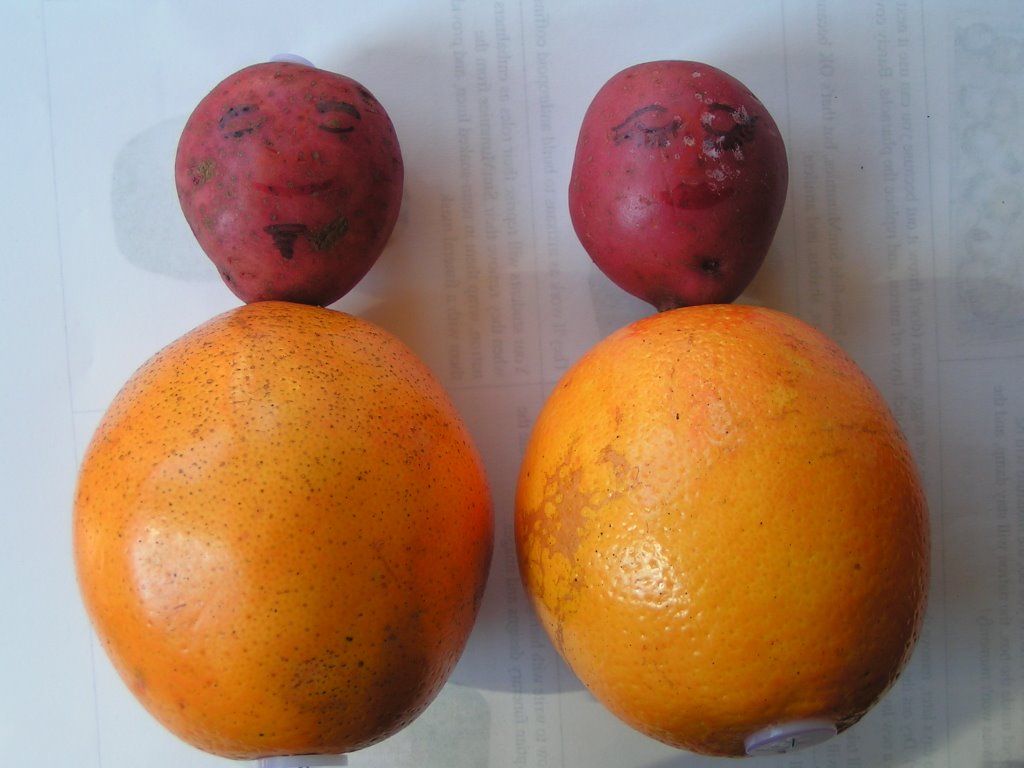
The first step was figuring out what, exactly, to mummify. I ended up assembling two little “bodies” using oranges and small, new potatoes, held together with wire. I drew faces on the potatoes--one male and one female—and explained to Moonheart and RobotBoy that these were the bodies of the pharaoh and his beloved wife, tragically killed by some mysterious ancient disease.


My students were appointed the official royal embalmers and went immediately to work.

They made an incision on the side of each abdomen and used the appropriate ritual tools to remove as many of the “internal organs” as possible. (Crochet hooks of various sizes and some spoons worked pretty well for this.) They saved all the orange flesh and seeds to package up and mummify separately.

Meanwhile, I mixed up a batch of “natron,” made by combining equal parts baking soda and salt.

Once the kids got tired of pulling out gooshy bits, the bodies were ready to be cleansed and anointed with “wine.” (I poured a bit of rubbing alcohol into a pretty bottle that had once held maple syrup and added a couple of drops of red food coloring.) After that, they made little packets of natron wrapped in fabric with which to stuff the body cavities of the mummies-to-be. They inserted the packets, sprinkled on some spices (mostly cinnamon powder), then turned their attention to the “organs.” They gathered up as much of the orange flesh and seeds as possible and wrapped them up into little packets inside paper napkins. We tied off each packet with a bit of string and wrote an initial to identify which organs belonged to which body. Then, we placed both bodies and the organ packets into an aluminum foil baking dish and surrounded it all with more natron.


We let them sit for several days, until the natron got really soaked and crusty. Then I removed it and replaced it with a fresh layer, after which we let them sit there desiccating for another few weeks. In the meantime, we went to work on their funeral goods and furnishings.

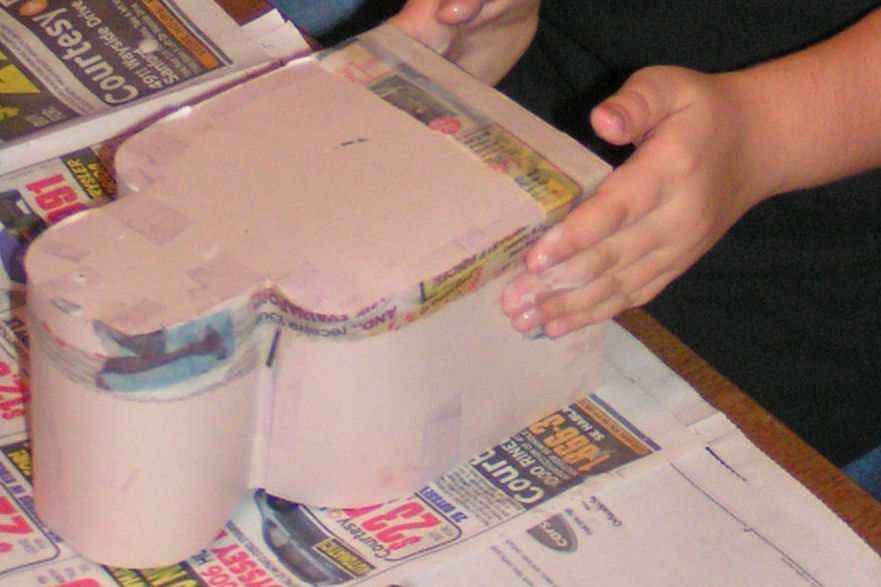
First up, was the coffins. I traced an outline roughly the shape of the bodies—with plenty of extra room to accommodate their eventual wrappings—onto cardstock. In retrospect, it would have been better to go with something a bit heavier for the top and bottom, since we found the cardstock had a tendency to warp later in the process. We used a combination of tape and glue to make the sides of the coffins by attaching strips of cardstock to the bottom. The kids then covered both inside and outside, top and bottom of each coffin with papier mache. (We left the lid alone for the moment, by the way. More on that later.)


By the way, I want to make it clear that this entire process unfolded over the course of about two months. We’d work on individual projects a little at a time, one or two afternoons a week. During the same period, we were continuing our study of ancient Egypt, which provided us with lots of ideas for things to add to our royals’ funereal outfittings. We watched several videos and DVDs and did a couple of great field trips to museum exhibits of Egyptian art and artifacts, including the wonderful Tutankamen exhibit that traveled the United States last year.

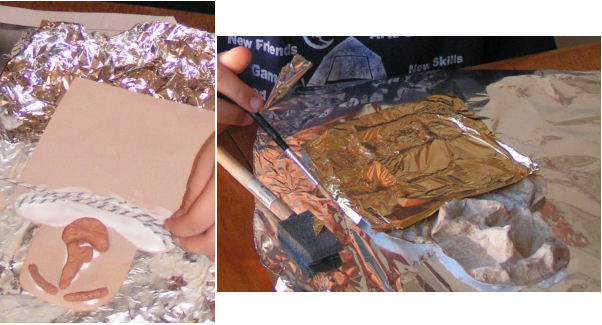
When next we had a chance for a craft project afternoon, I broke out the air-drying terra cotta clay and put my apprentice embalmers to work making canopic jars, amulets and shabtis, as well as some facial features to use on the coffin lids. To streamline the process just a bit, each kiddo made a single canopic jar, instead of the traditional four, since each mummy had yielded only one packet of “organs.”


Once all the clay pieces were dry, they were painted. We chose a reasonably accurate bright blue for the amulets and shabtis, but my young artists went a bit farther afield in decorating the canopic jars and other pieces.

The kids also painted the coffins with assorted designs inspired by our reading, research and field trips. They embellished the lids of the coffins by gluing down the facial features and other materials, then doing a thin layer of papier mache over the top. As a finishing touch, they later applied gold leaf.


About six weeks after we first put them in the natron, we decided the bodies were ready to wrap. It was pretty amazing to see and feel how dehydrated they had become.


Each little “body” got a base layer of wrapping made with strips of fabric brushed with the glue-flour-water mixture we used as a stand-in for resin. Once the first layer was dry, the kids did another round of wrappings, this time tucking in the amulets they had made and painted.


Each little packet of internal organs was also wrapped

We did a few final touches, including tiny beaded necklaces and, for one of them, an aluminum foil mask.


We also provided our tiny mummies with a few neccessities for the afterlife, including loaves of (salt dough) bread and faux alabaster vessels representing assorted other foods and beverages. Finally, the wrapped organ packets were placed into their waiting canopic jars and sealed. When all was said and done, we ended up with a very impressive little display, which is now spending eternity on top of a bookcase in our living room.


This was, truly, a wondeful project, both fun and educational. I just hope I can come up with something to top it this year!

Friday, September 08, 2006

A Day in the Life, Part 2

Wednesday was a fairly typical day, except that Robot Boy’s assignments were a little lighter than usual. (I had to juggle some portions of my lesson plan last week, and he ended up with a little less to do this week than usual.) However, one day a week, we aim to spend most of the day doing the “special stuff.” We inaugurated this approach about three years ago, starting each week with Art & Music Mondays. It went over so well that we’ve used some version of it every year since. The day of the week and the specific subjects we save for that day vary, but the basic idea has stuck.

This year, our day has turned out to be Thursday. We found that not doing a full day of regular academic stuff on Monday made us feel like we were losing momentum going into each week. So, we now plan our chemistry labs, drawing lessons and rhetoric—in addition to one or two of the other “together” projects for that week—for Thursdays.

We had such a good day yesterday that I decided I wanted to share it.

Both kids worked until about 10:00 on their usual morning subjects. Moonheart finally made contact with her chemistry instructor and did the oral quiz. She did really well and got a pep talk from the teacher encouraging her to go ahead and try the honors track assignments. Robot Boy did a math lesson and put a lot of energy into thinking up reasons to stall doing his science reading and summary until the afternoon.

By the time Moonheart was ready to take the guinea pigs out for their patio play time, I had gathered all the materials for the day's chemistry lab. We all moved out onto the patio and got ready to blow things up . . . I mean “do science.”


Yesterday's experiments were about combustion gases. We spent about 90 minutes playing with fire: scorching things to see the carbon, trapping carbon dioxide in a jar and using limewater to test for its presence, burning sulfur, testing for sulfur dioxide, learning about the greenhouse effect and acid rain. All went smoothly, and both kids had a great time.

We cleaned up and put away the equipment, then took a break for lunch before reconvening at about 1:00 for art at the kitchen table. Moonheart produced some really lovely pastel drawings, and Robot Boy enjoyed practicing drawing foreshortened squares. Once they had gotten to the point at which both of them were just doodling or working on their third or fourth drawing of the day, I pulled out the Art of Argument, and we read through the introduction to fallacies of relevance. They had fun trying to think of examples of all the various types.

We took another little break, then got out the globes and colored pencils and went to work on the map of the Islamic Empire. As usual, Moonheart wanted to linger over her map, coloring and shading things and labeling every visible land mass and body of water. Robot Boy finished his map much more quickly and got started on the long-delayed science assignment. He read and outlined two pages in the DK Eyewitness Chemistry book about “The First Chemists.”

About the time he finished, we were ready to leave for music lessons. We listened to the radio on the way there, and practiced trying to identify the various fallacies in the news.

Moonheart has 30 minutes each of guitar and piano, after which Robot Boy has his piano lesson. So, normally, I have to sit around alternately entertaining and shusshhhing him while we wait his turn. Yesterday, however, I realized just as we pulled up in front of the store that I had forgotten my purse at home. It was the first Thursday of the month, meaning tuition was due, so I got to spend that first hour while Moonheart was in her lessons making the round trip back home and back to the store to collect my credit card. We arrived back just in time for Robot Boy’s lesson.

I did get one piece of great news, though: Robot Boy’s piano teacher had a lesson slot open up 30 minutes earlier! This means that we can now get all three lessons into 60 minutes rather than 90 and be back home for dinner with Dad half an hour earlier.

Moonheart was happy and excited to be able to show her teachers how well she has done this week after instituting the new practice routine. She earned praise from both and more to work on this week. Robot Boy had a good lesson, too.

While Robot Boy was in his lesson, Moonheart talked me into doing a couple of Mad Libs with her. We got really into it, trying to outdo each other coming up with obscure and outlandish words—She set the bar right at the beginning with “lugubrious”--and found ourselves laughing so hard we had to wipe away tears. It was a really nice way to play with my kiddo.

We came home to a crock pot full of spaghetti sauce and the garlic bread I had prepped in advance and had a nice dinner with Dad. We watched an episode of the PBS show “History Detectives” that we had recorded earlier in the week, and I then left the three of them working on a project while I went out foraging for some much-needed groceries.

By the time I got home, it was time to send the kids off to bed. (Actually, they ended up staying up a bit late, because Dad lost track of time while I was gone. I doubt it will do them any permanent harm.)

So, there you have it, a snapshot of the other kind of “typical day.” It’s nice when it all goes well.

Wednesday, September 06, 2006

So, How Does It Really Work?

Okay, I’ve written quite a lot about what materials we’re using this year. I thought it might be interesting now to talk about how we do it all and what our days look like.

I dub thee . . .

Before I continue, though, there has been much pleading and begging from both of my children that I quit referring to them as generic “daughter” and “son” and give them nicknames. So, with all appropriate ceremony, I hereby dub my daughter “Moonheart” (envision the traditional tapping with a sword—or maybe a giant pencil—on each shoulder) and my son “Robot Boy.”

And now, a day in the life of Tweaked Academy:

We’re making an effort to get more of a head start on our days, so Moonheart and I have agreed to try getting up by 6:30. She is at her most productive and focused early in the day. So, the theory is that this will allow her time to practice at least one instrument and eat breakfast, shower and dress and still sit down to desk work before 9:00.

Robot Boy always gets up early, but has a tendency to loll on the couch (sometimes even going back to sleep for a bit). That’s where he was when I emerged from my bedroom this morning. Moonheart had taken her guitar into her room to practice.

We’re reading aloud A Connecticut Yankee in King Arthur’s Court and are getting through a chapter or so a day over breakfast. However, this morning both kids started on desk work before I had breakfast ready, so we ended up puzzling out a problem from Moonheart’s economics course while they ate.

After breakfast, they took turns in the shower and getting dressed while the other one got back to work. Both usually begin the day with whatever assignments they have in their virtual school courses. Moonheart was delighted to find an e-mail from her economics instructor letting her know she got a perfect score on yesterday’s assignment. She also traded a couple of e-mails with her chemistry instructor to make an appointment for her upcoming oral quiz. Meanwhile, Robot Boy did some review for the oral math quiz he had on his agenda for the day, He re-did an assignment on order of operations on which he had gotten a less-than-wonderful score and wound up with a much better grasp of the concept and a perfect score. I wandered in and out doing dishes and laundry and checking my own e-mail.

Once everyone was cleaned up and dressed, Moonheart continued to plug away at economics for a while, while waiting for her phone appointment with the chemistry instructor. Robot Boy did his oral quiz and earned lots of praise from the teacher. I will admit to being a bit nervous on his behalf about this aspect of the course, since it required him to work problems in real time with an audience, but he did great. I was very, very proud of him.

Next on Robot Boy’s checklist for today was some reading in one of his history books. He read two pages about Alfred the Great and wrote a few sentences to outline what he read. His spelling and punctuation are still pretty shaky, so our approach to this is to have him narrate to me what he wants to say. I then either write out or type and print this, and he uses it as a template to write out a good copy. After that, he moved on to a couple of pages in Latin for Children Primer B.

By around 11:00, Moonheart had made revisions to yesterday’s composition exercise (from Wordsmith Craftsman), then went on to her own Latin assignment (So You Really Want to Learn Latin Book III). She had left two messages for her chemistry instructor, but had not yet managed to connect.

Robot Boy had a really good day today and worked very efficiently. It probably had a lot to do with knowing that he had dance classes in the evening that he would not be allowed to attend if he was behind in his schoolwork. Classes were cancelled last Wednesday in anticipation of a major tropical storm and again on Monday because of the holiday, and he is very anxious to get back. Consequently, by 11:30 he had blown through not only math, history and Latin, but also vocabulary (Word Roots A2) and Logic Liftoff. He had finished his assigned reading from Robert Nye’s Beowulf: A New Telling (which he’s enjoying), leaving only a few Latin and logic corrections to make and his 30 minutes of piano practice.

About that time, Moonheart took our guinea pigs out on the patio for their daily play time. She took her German text and study guide out there and drafted me to come work with her on this week’s assignments. (For the record, I have no background in either economics or German, but I get elected to help with them, anyway!) We made our way through a dialogue and translation exercise before I had to go in an clean the piggies’ cage.

The kids fed both fish and the cat, and all the humans who were interested had a snack, too. Since Robot Boy had finished all his independent work, I gave permission for him to watch a bit of TV. I then insisted he get some air and exercise, so he took the portable stereo and his new CD and a ball out onto the patio. (He took the cat, too, but Sir Piggers seemed more interested in checking out the lizards and insects than in playing catch.) He couldn’t stay out long, unfortunately, because it’s just so very hot today. He came in and logged his time at http://www.presidentschallenge.org/. (Both kids are working toward awards as their official PE for the year.) Then he played on the computer for a little while.

Moonheart read a few pages of Morris Bishop’s The Middle Ages and gave me a quick oral summary of what she read. She grabbed the globe and showed me how the political borders are different now from what they were then. She then put in some time with her statistics course.

Meanwhile, I tried to decide what to do with the kids during our afternoon “together learning time.” Each week, in addition to the assignments for each child, I have a list of activities and projects and DVDs and so on that I want to do with both of them together. For example, since Moonheart is currently reading selections from the Koran and both kids are covering the rise of Islam in assorted history books, yesterday we perused the gorgeous illuminated Koran at the British Library’s wonderful Turning the Pages website [ http://www.bl.uk/onlinegallery/ttp/ttpbooks.html ]. We also worked on their year-long project to illustrate and build their own periodic table.

Today, I’m leaning toward a virtual field trip to the Alhambra [ http://www.saudiaramcoworld.com/issue/200604/ ] and either some map work on the Islamic empire or completing their History Scribe/History Scholar notebook pages on Mohammed.

I used my 45 minutes of “free time” to fold laundry and managed to get through all of it, despite the fact that the cat insisted on “helping” me. (Okay, full disclosure: There is still one load of towels in the dryer, but they aren’t dry yet. So, that doesn’t count.)

Just before 2:00, Moonheart took a break and we all went for a quick walk down the street to the mailbox. And, of course, we had to stop and admire the fairy village of mushrooms growing in a corner of the front yard. She practiced her piano pieces for the week while Robot Boy cleared his desk and I found the website I wanted them to explore.

We spent an hour or so exploring every facet of the virtual Alhambra tour, which was very cool. Then I handed out the notebook page templates and set them to work on writing about Mohammed and Islam while I threw together a quick dinner. Robot Boy is not big on writing more than necessary, so he finished up his page fairly quickly. Moonheart likes to linger over these projects, though, and particularly enjoys adding drawings and embellishments. So she packed up her encyclopedia and the box of colored pencils and brought hers on the road.

Wednesdays are Robot Boy’s long evening at the dance school. He begins with an hour of tap, then does 90 minutes of ballet and conditioning. Moonheart and I staked out a couple of chairs in a relatively quiet spot with a table, and I read while she put the finishing touches on her Mohammed page. We did duck out long enough to make a quick run to Target for a new CD player/alarm clock for her room.

By the time class was over, the weather outside was truly scary, with loud thunder and some extremely impressive lightning. We ended up hanging around in the entry way with three other families waiting for a break. We finally made it back home about 8:45, said hi to Dad, sent Robot Boy off to bed, plugged in and set Moonheart’s new clock radio . . .

And now I have all the rest of the evening to myself.

All in all, it was actually a very good day. Long, but good. And I’m now daring to think that we might be starting to find a rhythm that will see us through this year.

But we’ll have to see how it goes tomorrow, right?

Thursday, August 24, 2006

Catching My Breath

We’re nearing the end of week 3, and I can state with cautious optimism that we seem to be settling into a routine that has some reasonable chance of working. Both kids have had some challenges in finding their feet this year, but that’s typical. I just wish I could remember that from year to year, instead of having it always catch me by surprise.

So, I thought today I’d stop and breathe and take stock of where we are.

History and Literature are going well. Both kids enjoyed the Arthurian selections, and my son is enthusiastically gobbling up some Scandinavian myths that I substituted at the last minute for the Time Warp Trio Viking book.


The assorted languages are, on the whole, proceeding well. My daughter is outright enjoying the new Latin series: So You Really Want to Learn Latin (Published in England by Galore Park). My son is working more and more independently and consistently in Primer B of Latin for Children. He’s also enjoying The Learnables Spanish and has begun to sprinkle his new vocabulary into daily conversations.

My daughter’s German II course is turning out to be a bit more demanding than she had anticipated. I think much of the problem comes from trying to make the transition from Rosetta Stone’s “immersion” approach to the more traditional, grammar-based, textbook approach. She had done all of Rosetta Stone’s Level 1 (which is supposed to be equivalent to two years of high school foreign language) and was supplementing with an additional workbook for grammar, but she’s feeling very frustrated by encountering so much unfamiliar vocabulary in the new text. For the moment, we’ve quit trying to reach specific weekly goals for the amount of work done and are focusing on having her get into the groove of spending at least a certain amount of time each day making some progress. I’m also getting a crash course in German—with which I have almost no familiarity—as I try to help her with the lessons and exercises. I do feel like she’s turning the corner, though, and gaining some confidence. I’ve floated the idea of slowing down to as little as half speed and taking a full year to get through the half-unit course, but I suspect she’ll begin to pick up the pace within a few weeks.


Composition and grammar are flowing right along. My daughter is very much enjoying Wordsmith and seems to be keeping up nicely with the do-it-yourself approach and the assignments. My son is, as always, trying to get away with doing as little actual writing as possible in his assorted language arts workbooks, but is making big improvements in his history outlines and science summaries. He seems to be very proud of his attempts at cursive and even asks to do some of his regular work that way.


My daughter is taking Statistics by distance education as her math for this year. She’s already had Algebra I and II and Geometry and really wanted a “break” before tackling Precalculus next year. She’s gotten a bit of a slow start, but seems to be adjusting now to the format of the course and getting more enthusiastic about the subject. I think it’s still too early to tell whether this one will be a hit or a miss.My son’s math course, as I’ve already mentioned, got off to a rocky start. Things do seem to be improving after our week of concentrated hand-holding. I’m still more involved than I would like in supervising to make sure he’s paying attention to and following the directions, but it is clear that the actual math is well within his reach. He recently did well enough on one of his assignments that the instructor asked permission to use it as a sample to show other students.


Science is also turning out to be more of a challenge for my daughter than I would have expected. She’s taking Chemistry through our state’s virtual high school, which we both thought she’d love. However, she’s struggling. And I can’t quite tell whether it’s because she’s genuinely not prepared, whether she’s just not putting in the required amount of effort or whether the course isn’t especially well designed. I have noticed already that there have been a few questions on the assessments and exams that seem to require students to recall information that is pretty detailed. She’s finding the work very frustrating, and I’m not sure where we’ll go from here.My son is doing fine with his science reading, and both of them are enjoying our weekly chemistry labs.


He is also enjoying his geography work. As a sort of appetizer, he’s working through the “Global Geography” section of The Complete Book of Maps & Geography. He’ll then move on to a World Geography workbook from Carson Dellosa. And we’re tying geography to our history studies by doing an activity or two each week from Knowledge Quest’s blackline historical map set.


Another bright spot in our days has been my daughter’s virtual AP Microeconomics course. This is something she chose to do for fun, and she’s finding the coursework very interesting. She did hit a snag with the first exam, but that’s a characteristic problem for her, and I’m confident she’ll get better.


Both kids are also enjoying their logic and rhetoric studies. Since we didn’t transition to the classical approach until my daughter started high school, she had never done “logic” in any systematic way. So, she’s doing a crash course this semester using the Oxford University Press Very Short Introduction: Logic. It’s light reading and a clear, no-nonsense and friendly style.My son continues to enjoy the Orbiting with Logic books from Prufrock Press. He’ll finish the series this year, so I’m already looking around for a good next step for next year.We’re working through The Art of Argument together, mostly orally over breakfast. Both kids are doing fine with it so far, and my son, especially, is intrigued with the idea of learning to “argue like a gentleman.”

So, all in all, the year is shaping up to be exactly as full and challenging as I had anticipated. We’ve already hit a few rough patches on the road, and I’ll admit to more than a few moments of really wondering whether a given curriculum is going to work. And, as you can see from the list above, there are a couple of things that are still a bit up in the air. However, if our experiences in previous years holds true, all of this will eventually fall into place.

Now I just have to turn my energies to hoping that happens soon!

Wednesday, August 16, 2006

Progress? And Back to the Nitty Gritty

Last week was rough, no doubt about it. So, I spent the weekend consulting with my husband and brainstorming and having a serious talk with my son. In a nutshell, here’s what we decided to try:

For this week, I will sit right with my son and help him try to find his feet in the online math course. I’ve been having him read the lesson materials aloud to me, work the practice problems in front of me and check his assignments with me before he submits the work. We’ve done two lessons so far this week, and he’s earned perfect scores (and booster shots of confidence) on both.

In addition, I’ve explained to him that, in general, there’s a new sheriff in town and that the kind of behavior we were seeing last week just won’t be tolerated. On Monday, I’m pretty sure he spent more time exiled to his bedroom than sitting at his desk. And, because his work for the day was not done when it was time to leave, he also had to stay home and miss his beloved drum lesson.

Since then, things have begun to improve. Yesterday was a long day, but it was productive, and he was sent to his room only once. Today, there’s been some dawdling, but no major incidents. And, by lunchtime, he was almost halfway done. So, not stellar, but a definite improvement. I’m trying to keep it in perspective.

So, let’s talk about something more cheerful.

Along with math, science seems to be one of those subjects that throws often homeschoolers for a loop. And I’ll admit we’ve had our ups and downs with both. I’m feeling pretty positive about our science plans for this year, though. Our focus for this year is on chemistry, although we won’t force ourselves to ignore any other interesting stuff that happens along.

My daughter is taking an online course through our state’s virtual high school. My son is using two DK Eyewitness books as his spine: Chemistry and Matter. He is reading and writing summaries of about four pages each week. My daughter’s online class includes both virtual labs and some hands-on activities. (They send students a kit.) However, the lab component looked a bit light for our science-enthusiast daughter. So, we invested in a nice, big chemistry set and are working our way through that with a few experiments each week. Needless to say, the chance to mix chemicals and flirt with danger has been a big hit. Both kids are telling everyone they meet about how I set things on fire during our first lab session.

And, of course, we can’t resist supplementing. So I have lots of fun videos and DVDs lined up. Both of my kids are big fans of the Standard Deviants and are looking forward to their Organic Chemistry series.

Other, non-science things that are going especially well so far include the map work and the History Scribe/History Scholar pages, both of which I was afraid might turn out to be tedious. As it has turned out, though, my daughter enjoys the map work so much that she actually asked me to “let her” do the whole set, even the ones I wasn’t planning to assign. We’re using the Middle Ages set of Blackline Maps of World History from Knowledge Quest, in case you want to check them out for yourself.

So, all in all, things are looking up this week, but I’m still collecting and considering fall-back options for my son’s math. I promise to keep you posted.

Friday, August 11, 2006

Well . . .

It seems the roller coaster metaphor was more apt than I might have hoped. It’s been a bumpy week.

My son has been having some trouble getting himself focused on doing good quality work. He’s (just barely) doing enough to merit checking off the assignments on his log sheet. Unless I sit right with him, though, and double check every inch and enforce some reasonable level of care and quality, he takes every opportunity to slide by with sloppy and incomplete work. It is, needless to say, very frustrating.

This year is also his first attempt at a course that makes him accountable to someone other than me. We chose to enroll him in an online math class, primarily because he and I just seem to have trouble communicating about math. This is one of the subjects in which, when it is going well, he is both enthusiastic and talented. I, on the other hand, have more math talent than I was ever given credit for during my own formal education, but lack a firm foundation and enough confidence to teach it well. We got on each other's nerves an awful lot last year. So, we decided it would be best to remove me from the equation.

This, too, has proved problematic, however, since he seems to be having a great deal of trouble adjusting to the interface. And I can’t tell for sure whether it is because the course is truly too much for him or because he’s treating it with the same casual attitude he’s bringing to all of his work. Whichever it is, in this first week, he's managed to earn the equivalent of a failing grade.

It seems to me that the only way I might improve this situation would be to supervise his work more closely, but I’m not sure that’s the right thing to do. The softy-type mommy in me wants to believe that a couple of weeks of hand-holding and helping him to develop a better routine and study habits might allow him to find his feet and be successful in the course. Another, sterner voice says I might help him become stronger by getting out of the way and giving him space to either succeed or fail (or learn to ask for--and politely accept--my help) on his own. A third, very tired voice suggests that it might all be too much trouble and I should just withdraw him from the class now and buy a few workbooks. (I'm trying to ignore the voice whispering reminders about the existence of various schools public and private.)

Needless to say, my head is a crowded and noisy place today.

On the positive side, my daughter approached this first week with enthusiasm and a newfound desire to get and stay organized. She actually typed up a plan at the beginning of the week of which assignments to do each day . . . and stuck to it. Even some of the assignments I was concerned would feel tedious to her have gotten done happily and well. Let’s hope it lasts.

At this point on a Friday afternoon, I’m just happy to be stepping off the ride for the weekend.

I’ll let you know how it goes next week.

Sunday, August 06, 2006

You Know That Feeling?

When you’ve decided to ride the roller coaster and you’re all strapped in and the train has pulled away from the loading area and you are waiting for the first big hill . . . .

And you have that frantic urge to wave your arms and scream for them to let you out because you changed your mind?

That’s kind of how I’ve been feeling all day.

Did I mention that tomorrow is our first day of school?

And, yes, I know it will be fine, probably good and possibly even great. I know that we will accomplish a lot and have a good time and look back on the year with pride and joy at all the things the kids learned and all the great experiences we had. But right now, I’m sitting in that roller coaster vehicle feeling it crank up to the top of that incline and wondering how on earth I let myself be talked into this.

And so, in order to distract myself, I’ve decided to chat in this note about somewhat lighter fare: the arts.

We’re big-time arts lovers around here, with the kids having certain areas of shared interest and each having their specialties, too.

In terms of formal studies at home, my daughter will be focusing on art history of the medieval and Renaissance era. She’ll be more or less following the suggested approach of The Well-Trained Mind, using a portion of The Annotated Mona Lisa as a base and then building out from there. We have a huge book I found on a bargain table a few years ago called A History of Art that we use for picture study and to supplement the Mona Lisa readings. I’ve made a list of a few possible museum field trips and stocked the Netflix queue with videos and DVDs about the art and artists of the time that we’ll sprinkle throughout the year. And, just for fun, I have a paint-your-own Renaissance masterpiece kit, with postcard-sized reproductions of several famous works.

My son will participate in as much of this as strikes his fancy, mostly the videos and the hands-on projects.

Both kids also decided that this was the year they wanted to learn to draw. (Well, to be more precise, my daughter decided it was her year, and my son decided she wasn’t going to get to do anything he wasn’t allow to do, too.) My daughter chose Drawing: A Complete Course from Walch, and my son decided on Mark Kistler’s Draw Squad. We stocked up on all the supplies we’ll need for the whole year in a single expedition to Michaels, just so that we’ll never have to skip a lesson because we don’t have things on hand. At this point, the plan is to do drawing together (using their separate books but sitting across from each other at the table) on Mondays after our science lab. I’m afraid that letting it wait until later in the week will allow it to get shoved out of the way by other things that might seem more pressing.

And then there are the outside classes and activities.

We all love theater, and we’ve been taking the kids to live performances even when they had to sit in strollers. For the last few years, we’ve started with season tickets for the Shakespeare Festival as our baseline and then just added in as much as we could manage to fit into our schedule and budget. Both kids have participated in community theater, although my daughter is more involved than her little brother just yet.

My daughter is starting her third year of singing with a choir affiliated with the Royal School of Church Music. My son is returning for another year of ballet, with a total of four classes a week this year.

Both of them started piano lessons last year, and each is adding a second instrument, My daughter had her first classical guitar lesson last week – and positively glowed for hours afterward. My son is starting lessons tomorrow with a local bagpipe and drum corp, learning to play the Scottish snare drum.

It makes for a very full calendar, but keeps them both happy. Like foreign language, this is an area in which I am sometimes a little stunned at just how much each of them learns and does.

Creak, creak, creak, creak, clunk, clunk, clunk, clunk . . . Do you hear it? We’re almost at the top of the hill. Guess I’d better hang on, ‘cause here we go!

Thursday, August 03, 2006

Languages: Dead and Alive

In the last couple of posts, I’ve told you all about the literature my students will be reading this year. But, of course, reading is only half of the “English” equation.

My older student writes very well and has been writing poetry and stories pretty much as long as she could hold a pencil. And up until now, we’ve always just treated the more formal writing as an outgrowth of her history and literature study. She would read a certain number of books, then write about what she read. When she was younger, this was in a pretty traditional book report format, which has developed over the years into longer and more complex essays. She’d turn in a draft, let me read it and suggest corrections, then take another stab at polishing it.

And it worked pretty well, except that she continues to find academic writing daunting. The product is usually very good, consistently earning her A’s even in her outside-graded courses. The problem is that getting her to actually sit down and do the writing is downright painful . . . for both of us.

So, this year we’ve decided to try a writing program called Wordsmith Craftsman. We looked at the online samples and descriptions of several different essay-writing books, and this is the one she thought looked most appealing. It’s designed for the student to do independently. I’ve helped her to figure out how to schedule the work, but the actual doing of it will be up to her. My hope is that the writing process will become much more “mechanical” (in the best sense of the word) by the end of this year and that she will build some confidence in this area.

My son has decided he likes the format and approach of the workbook series from Harcourt Family Learning. So, he will be working through three of their workbooks this year: Spelling, Language Arts and Writing. He will, of course, continue to outline his history and science reading and write book reports and narrations, too. And he’s looking forward to working on his vocabulary with the second installment of Word Roots software from Critical Thinking.

That pretty much does it for English.

Both of my kids are studying Latin. My daughter used Oxford Latin for her first couple of years, but is transitioning to the wonderful So You Really Want to Learn Latin series this year. She read through the second book over the summer to get used to the style and is ready to hit the ground running with Book III next week. She’ll be supplementing with their Latin Translations book, just for fun.

Meanwhile, my son will be working through Primer B of Latin for Children this year. He had a great experience with Primer A last year and is looking forward to continuing. He will have his own translation work to do, since the publisher’s Lilellus de Historia for Primer B coincides nicely with our historical focus for this year.

In addition to English and Latin, my daughter decided to learn German, “just for fun.” She worked through most of Rosetta Stone’s German Level 1 last year (which the publisher claims is equivalent to two years of high school language study) and did some supplemental grammar. I think this gave her a good foundation, but she feels ready to move on to a more conventional, grammar-based program. Again, after looking at several alternatives, we’ve decided to enroll her in a German 2 course offered by the University of Missouri’s distance education center.

Thank goodness for outsourcing! (More on that in a later post.)

Spanish is the modern foreign language of choice for my son. He’s dabbled in this for a couple of years with an assortment of materials off the bookstore shelf. He doesn’t seem to have retained a lot, though. So we’re making an effort this year to get serious. We’re going to give The Learnables a try, moving at approximately half the recommended speed.

I must confess that the whole area of foreign languages is one that occasionally makes me sit up and take notice. The fact is that the only one of the three foreign languages being studied in my home that I might be qualified to “teach” (at least to a beginner) is Spanish. And, although I had a few years of that language in high school and college, it’s pretty rusty these days. This is just one of the ways in which it is already clear my kids will surpass me educationally, and may already have done so. And, while I’m excited and proud that we’re able to offer them those opportunities, I do sometimes have trouble really accepting just how much they are learning and doing.

Tuesday, August 01, 2006

More Nitty Gritty

So, once I get the older student’s plan more or less set, I start working to mirror it for the younger one. I look for resources that cover the same general ground, but at a level appropriate for him. I don’t worry about keeping them in lock step; sometimes, my older one will be studying a topic that is clearly out of reach to her little brother, while other times there will be some topic that I just know will be of special interest to him.

And, of course, there are always a few books that I just happen to have sitting on a shelf because I found them at a used book sale and that are perfect for him this year, even though they don’t have obvious parallels with his big sister’s plan.

In “big picture” terms, though, I try to keep them together as much as possible, which means he, too, will be focusing on medieval and Renaissance history and literature this year.

As spines, he will be using:

Parragon’s Encyclopedia of World History (“Middle Ages” and “Age of Discovery” sections)
History of the World: The Middle Ages, Vincent Douglas
History of the World: Renaissance and Discovery, Vincent Douglas
Art and Civilization: Medieval Times, Giovanni Di Pasquale
History of Everyday Things: Renaissance and the New World, Giovanni Caselli

He’ll be outlining some of his reading assignments and also creating a notebook using the History Scholar page templates.

Whenever it seems appropriate, he’ll join his big sister in watching the historical documentaries and other films on her list. And I have certain selections that are just for him, including the Schlessinger Media Life in the Middle Ages series.

His assigned reading for this year includes the following:

King Arthur and the Knights of the Round Table, Andrew Lang
One-Hundred-and-One Celtic Read-Aloud Myths & Legends, Joan C. Verniero (We have a few books in this series, and my son reads them independently. He will not cover all 101, just a nice selection of the stories.)
Sailor Who Captured the Sea (Lovely illustrations based on the Book of Kells), Deborah Nourse Lattimore
Viking and Liking It, Jon Scieszka
Beowulf: A New Telling, Robert Nye
Proud Taste for Scarlet and Miniver, E. L. Konigsburg
Robin Hood of Sherwood Forest, Ann McGovern
Aladdin and Other Tales from the Arabian Nights, N. J. Dawood
Wulf the Saxon, G. A. Henty
Puffin Classics Canterbury Tales. Geraldine McCaughrean
Squire’s Tale, Gerald Morris (a comic re-working of the Gawain story)
In Freedom’s Cause, G. A. Henty
Second Mrs. Giaconda, E.L, Konigsburg
Da Wild, Da Crazy, da Vinci, Jon Scieszka
Who Was Ferdinand Magellan? S. A. Kramer
Exploration & Conquest, Betsy & Giulio Maestro
Medieval Feast, Aliki
Shakespeare Stealer, Gary Blackwood

We’ll also be reading aloud Mark Twain’s Connecticut Yankee in King Arthur’s Court during the first semester. I’m still deciding on a read-aloud selection for the Renaissance period.

As you can see, I’ve leavened the list with several comic or silly selections guaranteed to make this period fun for my young boy. He actually got very excited just digging through the shopping bag in which I was accumulating his reading material for the year. He kept pulling out books and reading the titles out loud and holding them up for me to see (as though they were his personal discoveries). Finally, he exclaimed, “Hey, a bunch of these are classics!”

It’s enough to make any homeschooling mom’s heart beat proud!

Monday, July 31, 2006

The Nitty Gritty (Part 1)

I mentioned that I usually keep the kids on the same major topics, with my younger student following his big sister’s outline. And that’s how I usually begin my planning, too. I start by laying out what the older one will be doing, then look for resources and materials that parallel those subjects at a level appropriate for my son. History and literature are really the foundation of classical education in our “academy.” So, I thought I’d begin this series of posts about our 2006-07 academic year by describing my daughter’s history and literature curriculum plan.

Last year, the kids studied ancient civilizations (year 1 of The Well-Trained Mind history cycle). Therefore, this year they will move on to the middle ages and Renaissance. We’re planning to cover from about 400 to 1650 CE. My daughter’s “spines” for the year will be:

National Geographic Visual History of the World
The Middle Ages, by Morris Bishop
The Italian Renaissance, J.H. Plumb

She will also be reading from a wonderful book called The Mammoth Book of How It Happened: Eyewitness Accounts of Great Historical Moments from 2700 BC to the Present, which offers primary sources and eyewitness accounts of historical events.

She’ll be creating a record of her history studies using the History Scholar templates (the high school version) from History Scribe.

The backbone of her literature program for this year is a list of 14 “Great Books,” which she’ll read roughly in chronological order. We did a bit of rearranging for a variety of reasons. Sometimes, just because things seemed to flow better that way, we placed a book in order according to the time in which it was set, rather than when it was written. And there were a few pieces that we moved in order to have the reading coincide with some other event. For example, local theater companies are producing three of the Shakespearean plays on her list, and I wanted her to read each one right before seeing the live show.

With all of that said, here’s the list:

Le Morte D’Arthur (selections)
Koran (selections – We’re using the Dover “Selected Suras” version.)
Beowulf (the McNamara translation)
Tale of Genji, Lady Shikibu Murasaki
Arabian Nights (selections)
Celebrated Cases of Judge Dee, Robert H. van Gulik
Mabinogion
King Lear
Canterbury Tales (selections)
Gawain and the Green Knight
Henry V
Richard III
Merry Wives of Windsor
Don Quixote

And we’re also planning on some more contemporary fiction and drama that relates to the era:

Anna of Byzantium
, Tracy Barett
Lion in Winter, William Goldman
Daughter of Time, Josephine Tey
Man for All Seasons, Robert Bolt
Anne of the Thousand Days, Maxwell Anderson
Nine Days a Queen, Anne Rinaldi

She has assorted short works on her list, including the “Gest of Robyn Hode” and selections from Geoffrey of Monmouth’s History of the Kings of Britain and Holinshed’s Historie of England.

I have a long list of videos and DVDs to watch from our local library and good old Netflix, including lots of documentaries and the film versions of some of the plays she’ll be reading. We’re also planning to watch episodes 15-30 of The Western Tradition series, available online at one of our favorite websites, www.learner.org.

It should keep her quite busy and engaged. I’ll admit this is one of my favorite historical periods, and I’m very much looking forward to sharing this with both kids.

Next time, I’ll outline my younger student’s plan and reading lists for the same topics.

Wednesday, July 26, 2006

As Good a Start as Any

Today seems as good a day as any to post my first official note here. We're a little more than a week away from the first day of our new academic year; the new desks are assembled and put in place; the bookcases are empty and waiting for us to fill the shelves with the books and curricula for this year; my lesson plans are (almost) complete . . .

So what do I want to say?

Well, several people have told me lately that it is a shame that my kids are the only ones who benefit from the work and planning I put into this homeschooling thing. And I've been encouraged to find some way to share whatever small amount of "wisdom" and experience I have with others.

Also, I know that I am always interested to see what other homeschoolers are doing and how they do it. Especially when I first got started, I found all those how-to books pretty unfulfilling: They seemed mostly to be long on inspiration and pep talks and general tips, but short on the kind of detail I really wanted.

So I've decided to share those details here.

In days to come, I'll start posting specifics about the books and resources my students will be using this year. For now, I'll start with the general outline.

We loosely follow the suggestions and framework from Susan Wise Bauer's book The Well-Trainined Mind, with a lot of adaptations and substitutions to fit our family's needs. I try to keep both kids working on the same general subjects and historical eras each year, with my younger student mirroring the older one's curriculum at his own level. This year's primary topics are:

Medieval and Renaissance History and Literature
Chemistry
Statistics
Logic and Rhetoric
Latin
Art History: Medieval and Renaissance
Drawing

My older student will also study German (her second year), Philosophy and Economics. My younger one is starting Spanish.

As you can see, we have a full year ahead of us! I hope you'll come back and check in now and then to see how we're doing.